


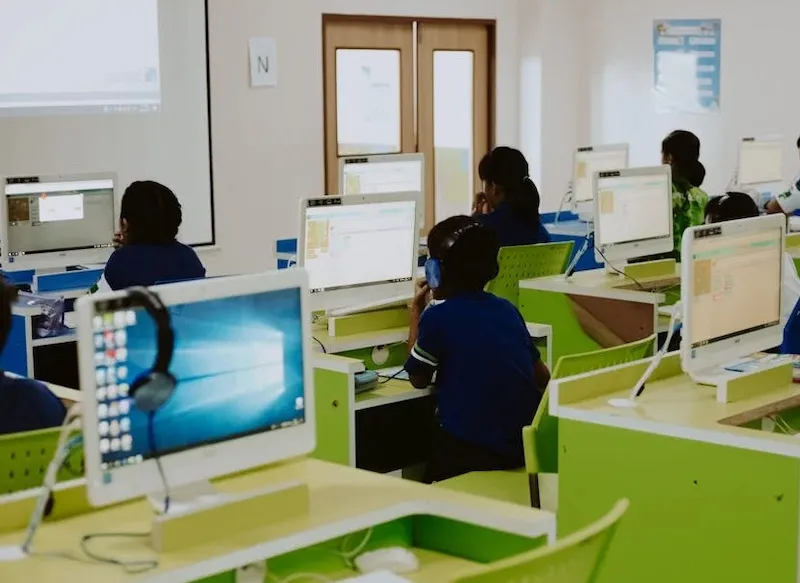
On any given afternoon, in classrooms across Uganda and beyond, literature teachers are confronting a quiet but profound shift.
The chalkboard is still there. The dog-eared novels still sit on desks. But in students’ pockets, and increasingly in teachers’ lesson plans, lives a new presence: artificial intelligence.
In recent years, AI has emerged as what many describe as a “transformative force” in education, particularly in the teaching of literature. Tools such as ChatGPT, DeepSeek AI, Next AI, AI Seek, Gemini and others are now part of the academic vocabulary.
Teachers are experimenting with them to make lessons more engaging, more interactive, and more responsive to students’ needs. Yet as with all revolutions, this one carries both promise and peril.
At its best, AI expands what is possible inside the literature classroom. One of its most significant contributions is the ability to analyze texts at speed and scale. AI tools can quickly identify themes, stylistic devices and character relationships across large volumes of text — work that once required hours of manual reading and note-taking.
Take David Rubadiri’s poem African Thunderstorm. When prompted, DeepSeek AI may interpret the storm as a metaphor for colonialism, while ChatGPT may frame it as a representation of the raw power of nature and its disruption of human life.
The contrast itself becomes a teaching tool. Instead of presenting a single authoritative reading, teachers can invite students into debate: Which interpretation feels more convincing? Why? What evidence supports each view?
Such comparisons can spark lively classroom discussions and encourage students to defend their ideas with textual evidence. For lengthy novels such as Tess of the D’Urbervilles, AI can assist by summarizing chapters or highlighting recurring motifs, helping students navigate dense material more efficiently.
But as many educators are quick to emphasize, AI is not a replacement for human understanding. Used critically, it can be a supportive tool. Used uncritically, it risks flattening the very subject it seeks to illuminate.
AI’s promise extends beyond analysis. It has also broadened access to literature for students with diverse learning needs. Audiobooks, digital textbooks and explanatory videos make texts more accessible.
AI can simplify or summarize complex passages, allowing students to grasp difficult material more easily and locate resources quickly. In theory, this democratizes litera- ture. A student who once struggled with archaic language or long passages can now receive immediate clarification.
Research, too, has become faster. AI can summarize poems, novels, plays and critical essays in seconds, reducing the time spent searching through physical books or scattered online sources. For teachers pressed for time, and for students juggling heavy workloads, such efficiency is undeniably attractive.
Yet the rise of AI in literature classrooms has also triggered unease. One of the most pressing concerns is plagiarism. AI tools such as ChatGPT, Gemini and others can generate well-structured essays that closely resemble human writing.
Students may be tempted to copy and paste AI-generated responses, making it difficult for teachers to distinguish between original thought and machine-produced text. In some cases, multiple students may submit strikingly similar assignments because AI tools tend to draw from the same underlying patterns of information.
This complicates assessment and raises difficult questions about academic integrity. Beyond plagiarism lies a subtler but perhaps deeper worry: the erosion of originality. Literature is rooted in personal interpretation, creativity and the unique human voice.
AI generates responses based on existing data and patterns. It does not feel. It does not experience. It does not wrestle with ambiguity in the way a human reader does. Over-reliance on AI for interpretation risks weakening essential skills such as critical thinking and independent analysis.
When students outsource their engagement with a text to a machine, they may lose the opportunity to struggle with meaning — a struggle that often leads to deeper understanding. There is also the danger of overdependence.
When both teachers and students lean too heavily on AI, foundational skills such as close reading, sustained concentration and original thought may gradually weaken. Students may become less confident in forming their own interpretations, assuming that the machine’s response is more authoritative than their own.
In this way, literature — a discipline grounded in nuance, imagination and emotional intelligence — risks being reduced to a mechanical process. The challenge, then, is not whether to use AI, but how.
Artificial intelligence can enrich literature education if approached with clear boundaries and thoughtful guidance. Teachers must help students see AI as a supportive tool rather than a substitute for their knowledge and voice.
Assignments can be redesigned to emphasize process over product, asking students to explain how they arrived at an interpretation rather than simply presenting one. Educational institutions, for their part, should invest in training teachers to integrate AI effectively and ethically. Without such preparation, the technology may overwhelm rather than enhance the classroom.
