


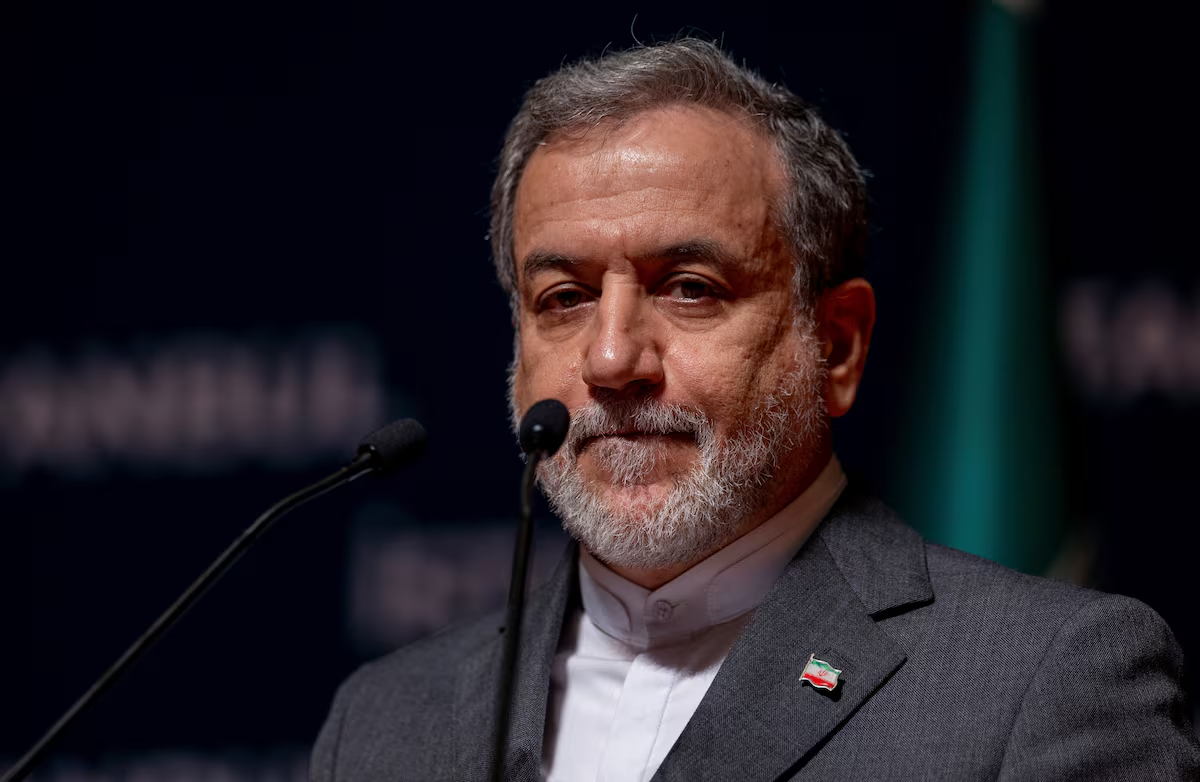
Iran’s position on nuclear weapons is not expected to shift in any major way, Foreign Minister Abbas Araqchi said in comments aired by Al Jazeera and carried by Iranian media on Wednesday.
He noted, however, that the country’s new supreme leader has not yet publicly stated his own position on the issue, leaving some uncertainty around how the matter could be handled going forward.
Iran’s former supreme leader, Ayatollah Ali Khamenei, who was killed in the early stages of the U.S. Israeli war against Iran, had long opposed the development of weapons of mass destruction. His view was rooted in a fatwa issued in the early 2000s.
For years, the United States, Israel, and other Western governments have accused Tehran of pursuing nuclear weapons. Iranian officials have consistently rejected that claim, insisting the country’s nuclear program is intended only for civilian use.
Araqchi said religious rulings depend on the Islamic jurist who issues them. He added that he is not yet in a position to judge either the legal thinking or the political direction of Mojtaba Khamenei, who has taken over as Iran’s new supreme leader.
The foreign minister also signaled that Iran wants a different future for the Strait of Hormuz once the war ends. In his view, countries along the Gulf should work together on a new protocol to govern movement through the strategic waterway, with terms that reflect both Iranian interests and those of the wider region.
That waterway has become a key flashpoint in the conflict. Iran has shut the strait, a route that normally carries about a fifth of the world’s oil and liquefied natural gas, saying it will not allow oil shipments to reach the United States, Israel, or their allies.
On Tuesday, Iran’s parliament speaker said publicly that the Strait of Hormuz would not return to the way it operated before the war.
Washington has been trying to assemble a naval coalition to escort ships through the area, but several NATO allies have shown little appetite for direct military involvement against Iran. France, while leaving the door open to international cooperation, said it would only consider such a coalition after a ceasefire and after prior talks with Tehran.
Araqchi made clear that, from Iran’s side, any real end to the war would require more than a pause in fighting. He said peace would only be possible if the conflict ends permanently across the region and if Iran is compensated for the damage it has suffered.
He also addressed criticism over Iranian strikes in Gulf states that have affected not just U.S. military targets but nearby residential and commercial areas. According to Araqchi, this happened because American forces had positioned themselves close to urban locations.
He said Iranian attacks were aimed wherever U.S. personnel and facilities were gathered, though he acknowledged that some of those sites may have been near populated areas.
Araqchi admitted that countries in the region are angry and that civilians have been affected or disturbed by the strikes. Still, he insisted responsibility lies with the United States, which Iran blames for starting the war on February 28.
If you want, I can make this even more like a breaking news blog post with a stronger headline, intro, and SEO title.
